

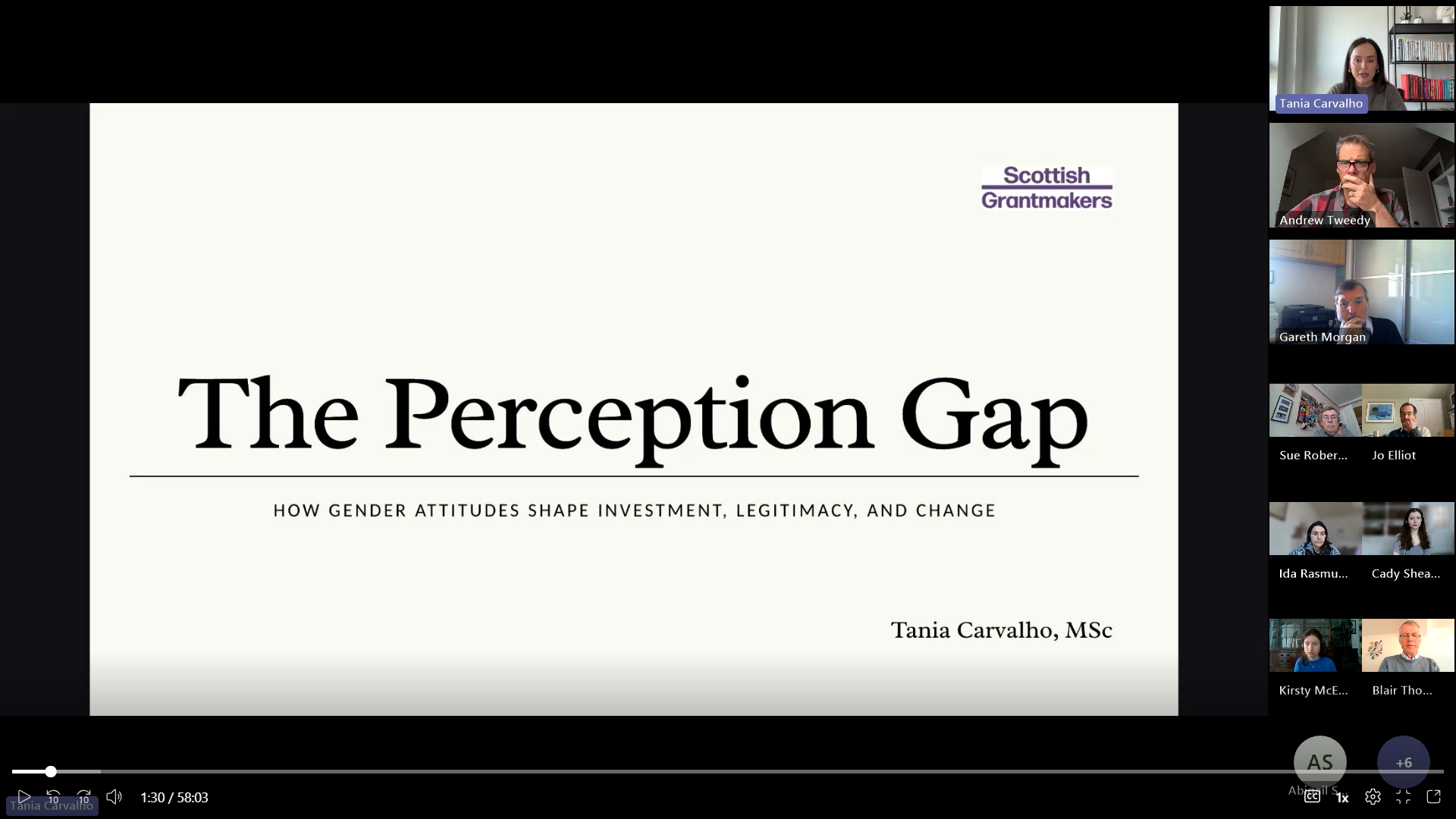
This session was led by researcher Tania Carvalho and grounded in her Master’s research into gender‑equality funding in the UK. Drawing on interviews with funders, trustees and leaders across the women’s sector, Tania offered what one Scottish grantmaker described as “fascinating and depressing in equal measure”: an examination of how assumptions about progress shape funding decisions, and a challenge to the deeply misleading belief that gender equality has largely been achieved.
The big picture: perception drives priority
The moment gender equality is declared “done” or “too-far,” support for women and girls becomes discretionary. The effect is not neutral: these perceptions inform funding strategies that determine which issues are prioritised and whose voices are heard.
Key statistics Tania shared
Just 1.8% of UK foundation grants go to women and girls.
In 2022, donkey sanctuaries received £51.7m in donations, compared with £11m for four leading domestic abuse charities combined.
91% of women’s organisations report rising demand, but only 52% are confident they can meet future need.
Local authority funding for women’s services has fallen by around 30% over the past decade, despite violence against women and girls being declared a national emergency.
As Tania stressed, the issue isn’t competing causes: it’s decision-making that deems some harms solvable and worthy of funding, while sidelining others as too complex or supposedly "resolved”.
New insights
The myth that equality is already achieved - Nearly half of the British public believe gender equality has been achieved or gone too far, quietly lowering urgency in funding systems and recasting gender equality as a “nice‑to‑have” rather than a strategic priority.
A zero‑sum backlash against women’s progress - Progress for women is increasingly framed as a loss for men, allowing resistance to funding women’s organisations to be recast as “fairness” rather than a corrective response to structural inequality.
Misogyny moving into the mainstream - Some donors now openly reference anti‑feminist figures, with online misogyny influencing funding conversations alongside a reported 300% rise in funding for anti‑gender movements across Europe.
The legitimacy burden placed on women’s organisations - Women’s organisations are repeatedly forced to justify the existence of gender inequality, an emotional and strategic burden compounded by chronic underfunding.
State retreat: As statutory services retreat, women’s organisations are left to absorb unmet need without the authority or stability to do so. Trapped in 12-month project grant cycles unsuited to structural problems.
How can Scottish Grantmakers help?
Treat gender equality as core work - Fund it as essential to the good of the community.
Use power, not just money - Male leaders provide important allyship, say clearly that gender equality matters and back it in funding decisions.
Fund organisations not projects - Give multi-year flexible funding. Cover core costs. Structural problems take time.
Shift decision making closer to communities - Let people most affected set priorities and decide what funding looks like.
Highlights from the discussion & Q&A
There was emphasis on reframing gender equality discussions to build broader coalitions.
Participants noted the lack of gender disaggregated data especially in large gender-neutral grants and intersectional charities.
The conversation widened to climate justice, homelessness, economic inequality, and pensions; showing gender issues across funding themes.
A powerful discussion reframed homelessness as not gender neutral with women facing distinct risks including hidden exploitation.
Although the questions below were directed to Tania, they continue to resonate as prompts for ongoing reflection:
Where do we assume progress, rather than evidence it?
Which women’s issues feel hardest to fund and why?
How can funding support long-term infrastructure, not just short-term delivery?
And ultimately: who gets to decide what causes and work progress?
All research discussed is credited to Tania Carvalho.
Tania delivered a truly impressive research presentation and we encourage you to support her work and learn more via her LinkedIn and website linked below.
Website: https://www.taniacarvalho.co.uk/
To catch up on the full session, Scottish Grantmakers members can access the video recording via the Events Catch‑Up page on our website. The password is the same as for the Members’ Area. If you've forgotten the password it can be found in the Staying in Touch section of our newsletter or requested directly by emailing scottishgrantmakers@wssociety.co.uk.
We hope you join us for our next mini-series this Summer all about AI:
An Introduction to AI - Ian McLintock -
Wednesday 20th May (13:00-14:15)
Register Now: SGM Member Meeting - Introduction to AI – Fill out form
AI and Grantmaking: Ask the Expert (Q&A) - Zoe Amar FCIM -
Tuesday 9th June (11:00-12:00)
Register Now: SGM Member Meeting - AI and Grantmaking: Ask the Expert (Q&A) – Fill out form
More details on this Summer AI Mini-Series coming soon!